|
|
People
 |
Janice Fischer
Principal Invesigator
Contact: jaf@mail.utexas.edu
Download CV
|
|
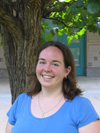 |
Susie Banks
Graduate Student
Recently,
our laboratory found that an additional endocytic protein, Auxilin, is
also essential for Delta internalization and signaling. Auxilin is
required for clathrin dynamics at two stages during endocytosis:
clathrin exchange prior to vesicle scission, and uncoating
clathrin-coated vesicles. Auxilin may prove to be a valuable tool for
determining why signaling cells need to internalize ligand. One popular
model suggests that Delta exerts a pulling force on the Notch receptor,
thereby inducing Notch cleavage and activation. In a second model,
endocytosed Delta is recycled back to the plasma membrane in active
form. So far, we have determined that Auxilin is required at least in
part to maintain the pool of clathrin required for Delta endocytosis.
We are performing experiments to determine why Auxilin is essential for
Delta endocytosis and why Delta endocytosis is required for Notch
activation.
Contact: sbanks@ mail.utexas.edu |
|
 |
Bomsoo Cho
Graduate Student
I'm
screening modifiers of epsin mutant phenotype to understand the Epsin
role in Delta signaling and also I'm studying the relationship between
Epsin and Ral-GTPase in Delta signaling.
Contact: bomsoo@mail.utexas.edu |
|
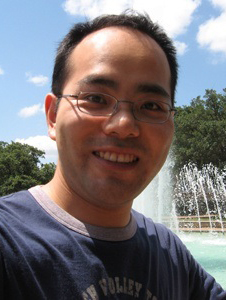 |
Ji-Hoon Lee
Graduate Student
Although
vesicular trafficking has already been a fascinating topic for cell
biologists, it is also an important source in regulating various
signaling events happening in multi-cellular organisms to construct
their whole body. I am interested in understanding how genes involved
in vesicular trafficking contribute to the developing organism, in the
context of signaling, using Drosophila as a model.
Specifically, I aim to figure out the role of a gene called liquid
facets-related. Using powerful fly genetics, I both test hypotheses
formulated from the mutant phenotypes and screen dominant modifiers of
a liquid facets-related mutant phenotype.
Contact: ol.jihoon @ gmail.com |
|
 |
Xuanhua Xie
Graduate Student
Notch
signaling is involved in the development of essentially all tissues in
metazoans. The Notch receptor and its ligands are transmembrane
proteins. One remarkable feature of the Notch pathway is that ligand
endocytosis into the signaling cells is a necessity in order to
activate the Notch receptor on adjacent cells. Epsin is an endocytic
protein that is critical for ligand endocytosis and Notch signaling. It
is a multi-modular protein with an N-terminal ENTH domain and several
protein-protein interaction motifs, UIMs, CBMs, DPWs, and NPF motifs. I
aim to gain insight into why Epsin-dependent ligand endocytosis is
necessary for signaling.
Contact: xuanhuaxie@mail.utexas.edu |
|
 |
Gerrit van der Ende
Graduate Student
Angelman
Syndrome (AS) is a neurological disorder in humans characterized by
severe mental retardation, epilepsy, and motor dysfunction. Patients
with AS have lost activity of the E3 ubiquitin ligase Ube3a in certain
regions of the brain. The disease likely results from the accumulation
of one or several proteins that are targets of Ube3a mediated
proteolysis. The identity of these Ube3a substrates is not known.
Little progess in the treatment of the disease can be made without
knowledge of the Ube3a substrates. Drosophila has a single homolog of
Ube3a, Dube3a. My research is in using genetics in Drosophila to
identify Dube3a substrate proteins that are relevant to Angelman
Syndrome.
Contact: gvanderende at mail.utexas.edu |
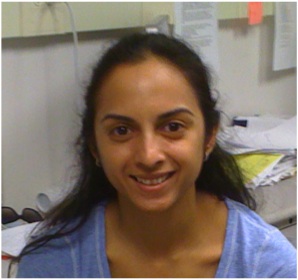 |
Sheila Bal
Graduate Student
Contact: sheilabal at mail.utexas.edu |
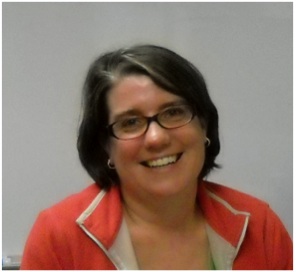 |
Kristin Patterson
Postdoctoral Fellow
Contact:kpatterson at mail.utexas.edu |
|
Former Lab Members
 |
Markay Isaac
Undergraduate and Research Technician
Contact: markay.isaac@gmail.com |
 |
Stephen Fleenor
Undergraduate and Research Technician
Ji-Hoon and I have identified 42 dominant modifiers of the lqfR
hypomorphic eye phenotype. I am testing these modifiers for
complementation, and through meiotic mapping, working with Ji-Hoon to
identify the specific loci of the complementation groups we have found.
Contact: stfleenor@mail.utexas.edu |
 |
Will Stoutt
Undergraduate Student
I am working with Susie.
Contact: kiba@mail.utexas.edu |
 |
Matt Glover
Undergraduate Student
I am working with Bomsoo.
Contact: mtg389@gmail.com |
 |
Alan Te
Undergraduate Student
I am working with Xuanhua.
Contact: alan.te@mail.utexas.edu |
 |
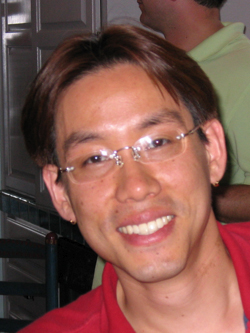
Martin Kracklauer
Former Graduate Student
Contact: martin.kracklauer@ gmail.com |
|
 |
Suk Ho Eun
Former Graduate Student
Contact: eun7615@hotmail.com |
|
 |
Yaning Wu
Former Graduate Student
Contact: yn_wu@yahoo.com |
|
| |
|
|
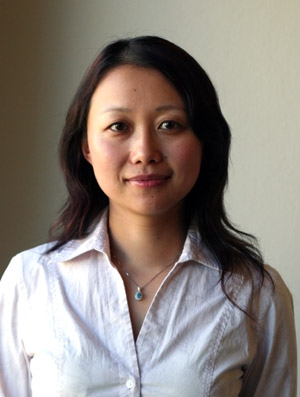 |
Xin Chen
Former Graduate Student
Contact: xchen32@ jhu.edu
View JHU faculty profile: http://www.bio.jhu.edu/Faculty/Chen/Default.html
|
|
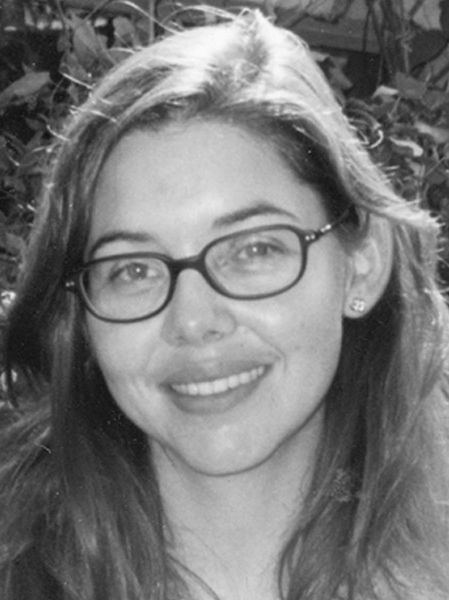 |
Angelica Cadavid
Former Graduate Student |
|
 |
Kathleen Mosley-Bishop
Former Graduate Student |
|
 |
Qinghong Li
Former Graduate Student |
|
 |
Yongzhao Huang
Former Graduate Student |
|
|
Lab News
- Stephen Fleenor is on his way to graduate school at Oxford!
- Markay Isaac is on her way to Vet School at A&M!
The Section of Molecular Cell and Developmental Biology is one of four units in the School of Biological Sciences. Other Sections are Integrative Biology, Molecular Genetics and Microbiology and Neurobiology.
|